EVA Film for Laminated Glass: Complete Guide
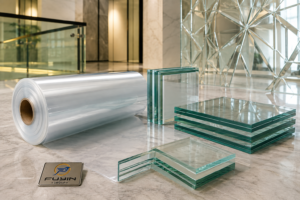
EVA film for laminated glass is a thermosetting interlayer used to bond two or more glass panels together during the lamination process. It is widely used in decorative glass, safety glass, smart glass, privacy glass and specialty architectural glazing.
Compared with some traditional interlayers, EVA film offers strong moisture resistance, high transparency and excellent compatibility with decorative materials. It can be processed in a vacuum laminating oven without requiring a large autoclave, making it a practical choice for many glass-processing factories.
Fuyin Group manufactures and supplies different types of EVA film for laminated glass, including super-clear EVA, high-clear EVA, colored EVA, white EVA, PDLC-compatible EVA and low-temperature EVA film.
What Is EVA Film for Laminated Glass?
EVA stands for ethylene-vinyl acetate. EVA film is placed between sheets of glass before the complete assembly is heated under vacuum.
During heating, the EVA film softens, bonds with the glass surfaces and then cross-links to form a durable interlayer. Once the lamination cycle is completed, the glass panels remain permanently bonded together.
If the laminated glass breaks, the EVA interlayer helps hold the broken glass fragments in place. This can reduce the risk of loose glass pieces falling or causing injury.
The final quality of EVA laminated glass depends on several factors, including:
- The quality of the EVA film
- Glass cleanliness
- Vacuum pressure
- Lamination temperature
- Heating time
- Cooling conditions
- EVA film thickness
- Compatibility with decorative inserts
How EVA Laminated Glass Is Produced
The EVA lamination process normally uses a vacuum laminating oven and silicone vacuum bags.
A typical production process includes the following steps.
1. Glass Cleaning
Both glass surfaces must be thoroughly cleaned before assembly. Dust, fingerprints, oil, moisture or cleaning residue can create bubbles, white spots or adhesion problems.
The glass should be completely dry before the EVA film is placed between the panels.
2. EVA Film Cutting
The EVA film is cut slightly larger than the glass dimensions. This helps ensure complete interlayer coverage during processing.
The film should be handled carefully to prevent contamination, wrinkles or damage.
3. Glass Assembly
The EVA film is placed between two glass panels. Decorative materials, printed films, metal mesh or PDLC smart film may also be inserted, depending on the product design.
The layers must be positioned correctly before entering the vacuum bag.
4. Vacuum Preparation
The assembled glass is placed inside a silicone vacuum bag. Air is removed using a vacuum pump.
Correct vacuum pressure is important because trapped air may produce bubbles inside the finished laminated glass.
5. Heating and Cross-Linking
The glass assembly is heated according to the recommended processing cycle for the selected EVA film.
The temperature and processing time may vary according to:
- EVA film formulation
- Film thickness
- Glass thickness
- Glass dimensions
- Oven performance
- Number of glass layers
- Type of decorative insert
The recommended technical datasheet should always be followed.
6. Cooling and Inspection
After lamination, the glass must cool before it is removed from the vacuum bag.
The finished glass should be inspected for:
- Air bubbles
- Edge separation
- White spots
- Uneven transparency
- Film movement
- Wrinkles
- Contamination
- Incomplete adhesion
The excess EVA film around the glass edge can then be trimmed.
Main Types of EVA Film for Laminated Glass
Different EVA formulations are available for different applications. Selecting the correct product is essential for achieving good optical appearance and long-term performance.
Super-Clear EVA Film
Super-clear EVA film is designed for laminated glass requiring high transparency and low haze.
It is commonly used for:
- Clear decorative laminated glass
- Glass doors
- Interior partitions
- Display glass
- Furniture glass
- Transparent architectural panels
- Premium decorative applications
Super-clear EVA film helps reduce the cloudy appearance that may be visible with lower-grade interlayers.
For projects where optical quality is important, the glass type should also be considered. Extra-clear glass can provide a better result than standard clear glass, especially in thick laminated constructions.
High-Clear EVA Film
High-clear EVA film provides good transparency for standard laminated-glass applications.
It may be suitable for:
- Interior partitions
- Shower enclosures
- Glass doors
- Decorative panels
- Office glass
- Furniture
- General safety glazing
The difference between high-clear and super-clear EVA usually relates to optical performance, haze, transparency and final appearance.
Customers should compare the technical data and sample results before selecting a grade for large-volume production.
Colored EVA Film
Colored EVA film is used to produce decorative laminated glass in different colors and opacity levels.
It is suitable for:
- Hotels
- Shopping centres
- Residential interiors
- Office partitions
- Decorative doors
- Wall panels
- Furniture
- Artistic glass
- Privacy glass
Colored EVA film can create a uniform appearance without adding paint to the glass surface.
Available colors may include white, translucent white, black, grey, blue, bronze and customized colors, depending on production requirements and minimum order quantities.
White EVA Film
White EVA film is commonly used for decorative and privacy glass.
Different white grades may provide different levels of light transmission and opacity. Some products create a soft translucent appearance, while others provide a more solid white finish.
White EVA film may be used in:
- Office partitions
- Bathroom glass
- Privacy panels
- Kitchen glass
- Decorative wall panels
- Hotel interiors
- Retail displays
PDLC EVA Film for Smart Glass
PDLC-compatible EVA film is specially designed for smart-glass lamination.
PDLC smart film contains sensitive electrical and liquid-crystal components. Using the wrong EVA film or excessive lamination temperature may damage the smart film, reduce transparency or cause performance problems.
PDLC EVA film is used in applications such as:
- Meeting-room privacy glass
- Hospital partitions
- Hotel bathrooms
- Residential smart glass
- Executive offices
- Banks
- Clinics
- Showrooms
- Commercial interiors
When the power is switched on, the smart glass becomes transparent. When the power is switched off, it becomes opaque or translucent.
The EVA film used around the PDLC layer must provide strong bonding while protecting the smart-film components.
Low-Temperature EVA Film
Low-temperature EVA film is designed for materials that may be damaged or deformed by standard lamination temperatures.
It can be used for selected applications involving:
- Acrylic sheets
- Temperature-sensitive decorative films
- Printed materials
- Specialty plastic layers
- Selected smart-glass components
A trial lamination should always be completed before starting mass production.
The successful processing temperature depends on the EVA formulation, thickness and inserted material.
Acoustic EVA Film
Acoustic EVA film may be used in laminated-glass constructions designed to reduce sound transmission.
The sound-reduction performance of laminated glass depends on the complete glass composition, including:
- Glass thickness
- Interlayer thickness
- Air space
- Number of glass layers
- Glass asymmetry
- Frequency of the sound
- Installation system
The interlayer alone does not determine the final acoustic result. Laboratory testing of the complete glass construction may be required for project approval.
Common EVA Film Thicknesses
EVA film for laminated glass is available in different thicknesses. Common options include:
- 0.25 mm
- 0.38 mm
- 0.50 mm
- 0.76 mm
- 0.80 mm
- 1.14 mm
- 1.52 mm
- 3.00 mm for selected applications
The correct thickness depends on the glass type, panel size, design, intended use and local safety requirements.
0.25 mm EVA Film
This thin EVA film may be used for selected decorative applications or combined in multiple layers.
It is generally not selected as the only interlayer for large or safety-critical architectural panels without appropriate engineering and testing.
0.38 mm EVA Film
A 0.38 mm EVA layer is frequently used for small decorative laminated glass, interior applications and glass containing decorative inserts.
Several layers may be combined to achieve a greater total interlayer thickness.
0.50 mm EVA Film
A 0.50 mm EVA film can provide an intermediate option for decorative and general lamination work.
Its suitability depends on the glass dimensions and final application.
0.76 mm EVA Film
A 0.76 mm EVA film is widely used in standard laminated-glass constructions.
It may be suitable for:
- Interior safety glass
- Glass doors
- Partitions
- Decorative glass
- Smart glass
- General architectural applications
0.80 mm EVA Film
A 0.80 mm thickness is commonly available for PDLC smart-glass lamination and other specialty applications.
It may provide easier product selection where smart-film systems are designed around this thickness.
1.14 mm EVA Film
A 1.14 mm EVA interlayer can be selected for thicker or larger laminated-glass constructions where additional interlayer thickness is required.
Engineering calculations and applicable safety standards should still be considered.
1.52 mm EVA Film
A 1.52 mm EVA film is used for heavier laminated-glass constructions, multiple glass layers and applications requiring a thicker interlayer.
However, thickness alone does not determine structural performance. The complete glass design must be reviewed for load, impact, support conditions and installation location.
Applications of EVA Film for Laminated Glass
EVA film is highly versatile and can be used in many glass products.
Decorative Laminated Glass
One of the main advantages of EVA film is its compatibility with decorative inserts.
Materials that may be laminated between glass include:
- Fabric
- Metal mesh
- Printed PET film
- Decorative paper
- Leaves
- Photographs
- Printed graphics
- Colored film
- Special design materials
Every inserted material should be tested before production. Ink, moisture, coatings, chemicals or trapped air can affect adhesion and transparency.
Smart Glass
EVA film is widely used to laminate non-adhesive PDLC smart film between glass panels.
The EVA interlayer protects and bonds the PDLC layer while creating a complete smart-glass panel.
Correct busbar protection, wiring position, edge sealing and temperature control are essential during smart-glass production.
Interior Glass Partitions
EVA laminated glass is frequently used for office and residential partitions.
Clear, colored, white or smart-film combinations can provide:
- Safety
- Privacy
- Decoration
- Light control
- Custom design
Glass Doors
Laminated glass doors can be produced using EVA film to improve safety and retain glass fragments after breakage.
The correct glass thickness and hardware design must be selected according to the door dimensions and applicable standards.
Shower Enclosures
EVA laminated glass may be used in selected shower-enclosure applications, especially for decorative or privacy glass.
Because bathrooms have high humidity, the correct exterior-grade EVA formulation and proper edge preparation are important.
Staircases and Railings
EVA laminated glass may be used for selected staircases, balustrades and railings, subject to engineering approval and local building regulations.
For structural or fall-protection glazing, the complete glass construction must be designed by a qualified specialist. EVA should not automatically replace PVB or SGP in every structural application.
Furniture and Display Glass
EVA film can be used for:
- Glass tables
- Cabinets
- Shelving
- Display cases
- Retail counters
- Decorative furniture panels
Its decorative flexibility makes it popular with interior designers and custom-glass manufacturers.
Exterior Laminated Glass
Certain exterior-grade EVA films may be used for outdoor laminated glass.
Exterior suitability depends on:
- EVA formulation
- UV resistance
- Moisture resistance
- Edge exposure
- Sealant compatibility
- Glass design
- Local climate
- Installation system
Not every EVA film is suitable for permanent exterior exposure. Buyers should confirm the film grade and technical requirements with the supplier.
Main Benefits of EVA Film
Strong Moisture Resistance
EVA film generally provides strong resistance to moisture and humidity.
This can be advantageous in applications where the interlayer edge is exposed. However, correct installation and suitable edge treatment remain important.
Good Optical Clarity
High-quality EVA film can provide clear laminated glass with low haze.
The final appearance also depends on:
- Glass quality
- Glass iron content
- Film storage
- Vacuum quality
- Processing temperature
- Cleanliness
- Cooling conditions
Decorative Flexibility
EVA is one of the most flexible interlayers for decorative laminated glass.
It can bond many compatible inserts that may be difficult to process using conventional PVB.
No Autoclave Normally Required
Standard EVA laminated glass can normally be produced in a vacuum laminating oven.
This allows small and medium-sized glass factories to produce laminated glass without investing in a large autoclave system.
Multiple Colors and Formulations
EVA film is available in clear, white, colored, translucent, smart-glass and low-temperature grades.
This allows glass processors to manufacture a wide range of finished products.
Strong Adhesion
When processed correctly, EVA film provides strong bonding to glass.
Poor adhesion is usually related to incorrect processing, contamination, insufficient vacuum, unsuitable film or incorrect storage.
EVA Film vs PVB Film
EVA and PVB are both used for laminated glass, but they have different properties and processing requirements.
| Feature | EVA Film | PVB Film |
|---|---|---|
| Main processing method | Vacuum laminating oven | Pre-lamination and autoclave |
| Decorative inserts | Excellent compatibility | More limited depending on material |
| Moisture resistance | Generally strong | Requires careful storage and edge protection |
| Common applications | Decorative, smart and specialty glass | Architectural and automotive glass |
| Color options | Wide range | Clear and selected colors |
| Smart-glass use | PDLC-compatible EVA available | Less commonly selected |
| Equipment investment | Lower for many factories | Higher due to autoclave system |
| Structural use | Depends on grade and design | Widely specified in architectural glazing |
Neither product is automatically better for every application.
EVA is often preferred for decorative glass, smart glass and vacuum-oven production.
PVB is widely used for automotive windshields and architectural safety glass where established certifications and project specifications require it.
For high-performance structural glazing, SGP ionoplast may be more appropriate than either standard EVA or standard PVB.
EVA Film vs SGP Interlayer
SGP is a stiff ionoplast interlayer mainly used in structural and high-performance glazing.
Compared with EVA, SGP generally provides:
- Greater structural stiffness
- Better post-breakage performance
- Stronger suitability for demanding structural applications
- Reduced glass deflection in selected designs
EVA provides advantages in decorative compatibility, smart-glass lamination and vacuum-oven processing.
The correct choice depends on the project requirements and should not be based only on material price.
How to Choose the Correct EVA Film
Before purchasing EVA film, provide your supplier with complete project details.
Important information includes:
- Final glass application
- Interior or exterior installation
- Glass dimensions
- Glass thickness
- Required film thickness
- Clear, colored or white appearance
- Decorative insert type
- Smart-film brand and specification
- Required UV resistance
- Local safety standard
- Lamination oven type
- Maximum processing temperature
- Required width and roll length
Choose Super-Clear EVA When:
- Maximum transparency is important
- Extra-clear glass is being used
- The glass is designed for premium interiors
- Low haze is required
Choose Colored EVA When:
- Decorative appearance is the main purpose
- Privacy is required
- A consistent color is needed between glass layers
Choose PDLC EVA When:
- Laminating switchable smart film
- Lower or controlled processing temperature is required
- Electrical components must be protected
Choose Low-Temperature EVA When:
- Laminating acrylic
- Using heat-sensitive decorative materials
- Standard EVA temperature may damage the insert
Choose Exterior-Grade EVA When:
- The glass will be installed outdoors
- The edges may be exposed
- Strong moisture and UV resistance are required
Common EVA Lamination Problems
Air Bubbles
Bubbles may be caused by:
- Insufficient vacuum
- Dirty glass
- Moisture
- Wrinkled EVA film
- Incorrect heating cycle
- Air trapped around decorative inserts
- Vacuum-bag leakage
The vacuum system, bag seal and production method should be checked.
White Haze
White or cloudy laminated glass may result from:
- Incorrect temperature
- Insufficient heating time
- Moisture contamination
- Poor-quality EVA film
- Incomplete cross-linking
- Dirty glass
- Rapid or uneven cooling
Edge Delamination
Edge separation may be caused by:
- Contaminated glass edges
- Incorrect processing
- Incompatible sealant
- Insufficient EVA coverage
- Water penetration
- Unsuitable exterior-grade selection
- Poor edge finishing
Yellowing
Yellowing may be related to:
- Low-quality raw materials
- Excessive heating
- Long UV exposure
- Incorrect additives
- Contamination
- Incompatible inserted materials
UV-resistant EVA should be selected for projects exposed to strong sunlight.
EVA Film Movement
Film movement can happen when the glass layers are not secured properly before heating.
Incorrect assembly, excessive film overlap or poor vacuum control may contribute to the problem.
How to Store EVA Film Correctly
Correct storage is essential for maintaining EVA film quality.
Recommended storage practices include:
- Keep rolls in their original packaging
- Store in a clean, dry area
- Protect from direct sunlight
- Avoid high temperatures
- Keep away from dust and chemicals
- Do not place rolls directly on a wet floor
- Reseal partially used rolls
- Use older stock first
- Follow the supplier’s shelf-life instructions
Although EVA is less moisture-sensitive than PVB, poor storage can still create contamination and processing problems.
EVA Film Quality Checks
Before mass production, buyers should check:
- Film transparency
- Thickness tolerance
- Roll width
- Surface cleanliness
- Film consistency
- Adhesion performance
- Cross-linking result
- UV resistance
- Moisture resistance
- Haze level
- Packaging condition
A trial lamination should be completed using the customer’s actual glass, oven and production process.
Frequently Asked Questions
What is EVA film used for in laminated glass?
EVA film is used to bond two or more glass sheets together. It is commonly used in decorative glass, safety glass, smart glass, privacy glass and specialty laminated glass.
Does EVA laminated glass need an autoclave?
Standard EVA laminated glass is normally produced in a vacuum laminating oven and does not require an autoclave.
Is EVA film suitable for outdoor glass?
Selected exterior-grade EVA film can be used for outdoor applications. The correct formulation, edge condition, UV exposure and project requirements must be considered.
Can EVA film be used for smart glass?
Yes. Special PDLC-compatible EVA film is used to laminate switchable smart film between glass panels.
What is the normal EVA film thickness?
Common thicknesses include 0.38 mm, 0.50 mm, 0.76 mm, 0.80 mm, 1.14 mm and 1.52 mm.
Is EVA better than PVB?
EVA is often better for decorative inserts, smart glass and vacuum-oven processing. PVB is widely used for automotive and architectural safety glass. The correct choice depends on the application.
Can fabric be laminated between glass using EVA?
Yes, many compatible fabrics can be laminated between glass using EVA film. A trial sample is recommended before mass production.
Why are there bubbles in EVA laminated glass?
Bubbles can result from insufficient vacuum, dirty glass, moisture, leaking vacuum bags or an incorrect heating cycle.
How should EVA film be stored?
EVA rolls should be stored in their original packaging in a dry, clean area away from sunlight, high temperature, moisture and contamination.
Can multiple layers of EVA film be used?
Yes, several layers can be combined to achieve the required total thickness. The complete construction should be tested before production.
Why Buy EVA Film from Fuyin Group?
Fuyin Group supplies EVA interlayer film to glass processors, smart-glass manufacturers, façade companies and distributors.
Available products include:
- Super-clear EVA film
- High-clear EVA film
- Colored EVA film
- White EVA film
- PDLC-compatible EVA film
- Low-temperature EVA film
- Acoustic EVA film
- Customized thickness and width options
Fuyin provides manufacturing support in China and international sales support through its offices and operations in China, the UAE and the United States.
Customers can request:
- Technical datasheets
- Product samples
- Processing recommendations
- Thickness guidance
- International quotations
- Shipping support
- Custom sizes
- Technical consultation
View the complete Fuyin EVA interlayer film product range or contact Fuyin Group for pricing, samples and technical information.
Conclusion
EVA film for laminated glass is a flexible and practical interlayer for decorative glass, smart glass, safety glass, privacy panels and specialty glazing.
Its main advantages include strong moisture resistance, good transparency, compatibility with decorative inserts and the ability to process laminated glass using a vacuum oven.
Successful production depends on choosing the correct EVA grade, keeping the glass clean, maintaining stable vacuum pressure and following the recommended heating cycle.
For clear, colored, PDLC-compatible or low-temperature products, visit the Fuyin EVA film for laminated glass page to review the available film types, thicknesses and applications.